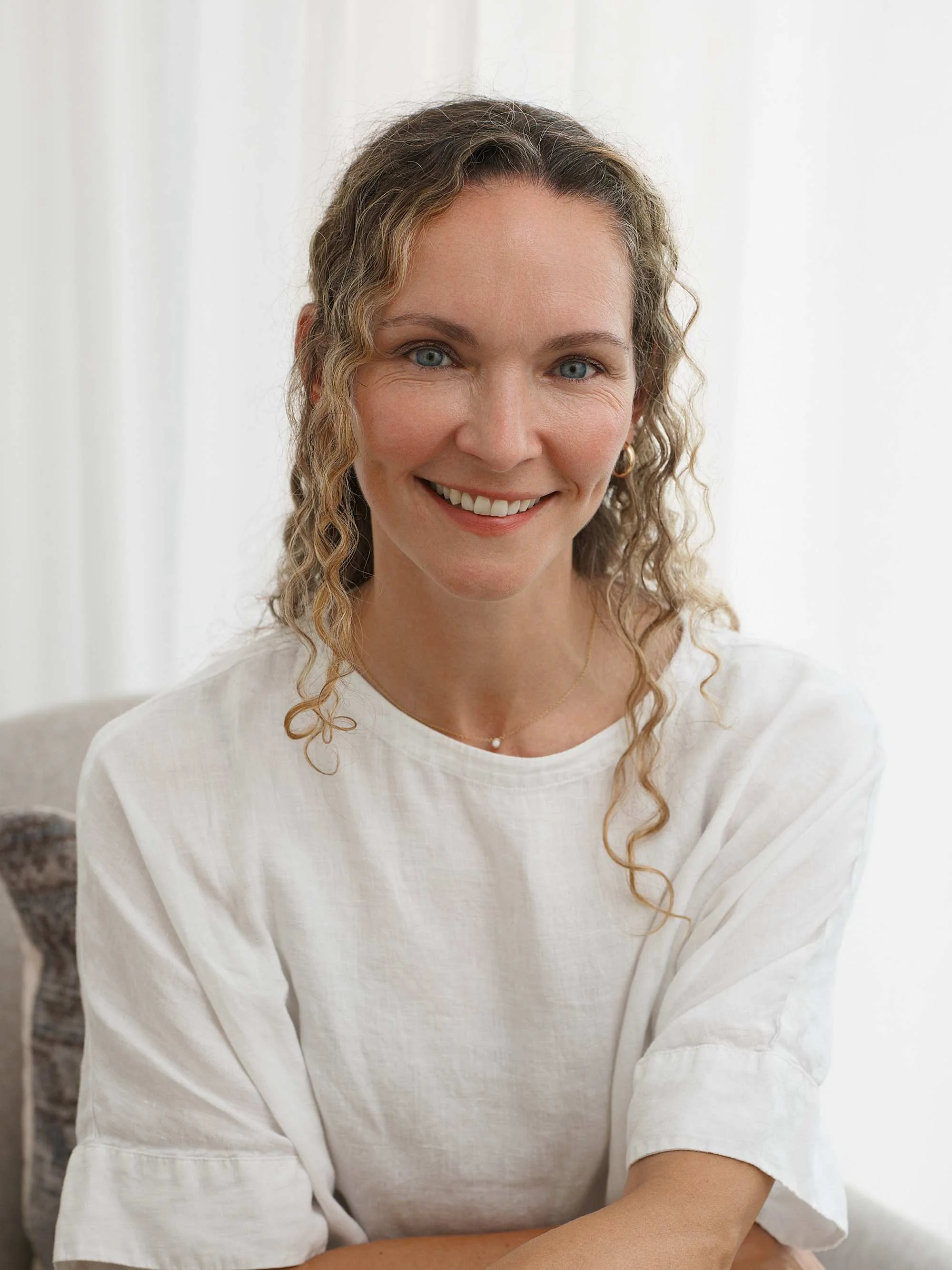
Registered Clinical Counsellor · Vancouver, BC
About Anna Williams, RCC
A little about how I work, what brought me here, and what you can expect if we work together.
My job isn't to have the answers.
It's to help you connect with your experience in new ways.
Easier said than done, though. Most of us arrive already knowing a lot about ourselves, but that knowing isn't always enough. What tends to be missing isn't information about yourself — it's how you relate to the information you have.
So we get curious, together, about new ways to be in connection with it.
How I got here
Why this work
Where it started

I first went to counselling as a teenager, and again as a young adult, during stretches of real change and uncertainty. It helped, and it shaped the direction my life took afterward. Counselling is still part of my life today, and I value what it means to sit in that chair.
Finding IFS
It was through parenting resources and my own professional development that I started hearing about parts work, and how it can support compassionate ways of relating to yourself and to others. It helped shift how I related to my own experience as a parent, and in turn, how I related to my kids. That was enough to spark my curiosity and professional interest, and I started studying Internal Family Systems work directly. What struck me was how collaborative and non-pathologizing the model is. Every part is welcome here, and nobody is a problem to be fixed.
Experiencing IFS as a client first
Before I brought IFS into a therapy room, I wanted to experience it myself. So I started working with an IFS Institute-trained counsellor, and it gave me more space to be with my experiences with compassion and new steadiness, instead of being swept up in them. I'm grateful for that, and I still return to it for myself — in service of my own wellbeing, and how I hold this work for others.


10 years of listening
What I've come to understand
Over the past decade working alongside adults, caregivers, and young people, I am continually awed by how creative and caring people's inner worlds are, even in the middle of difficulty.
Every landscape is shaped by what it's lived through. Ground hardened by too much control. Slopes worn down by storms that swept through. Low places that filled with water and were kept apart, holding what settled there.
Yours may be shaped in similar ways, and there's real intelligence in it. Whatever's been protecting you has worked hard to keep you safe, even when the strategy it's using may have been built for an older situation, one that doesn't quite fit anymore.
Getting to know your inner landscape means understanding why it's taken the form it has. Not to force it into something different, but to see what each part has been doing for you all along, and to find new ways to be with it, ways that make room for hope, and for healing.
What you can expect from how I work
An integrative approach
Rooted in Internal Family Systems, layered with mindfulness, nervous system awareness, attachment theory, expressive arts, and emotion-focused and dialectical approaches. Adapted to what you need and where you’re at.
A collaborative process
Therapy is a partnership. We’ll work out together what you’re experiencing and what you’re hoping for, moving at a pace that feels right rather than one I’ve decided on in advance.
A space to arrive as you are
You don’t have to arrive polished. You’re welcome as you are, including the parts you’re not sure about yet.
.
Sessions tend to move between conversation and something more experiential, sometimes mapping a part out on paper, sometimes slowing down enough to notice what’s happening in your body while we talk. Where it goes depends on what shows up.
Credentials and training
-
Registered Clinical Counsellor, BC Association of Clinical Counsellors, RCC #18626
-
Master of Counselling Psychology, Adler University
Bachelor of Arts, Psychology, with a minor in Gender, Race, Sexuality and Social Justice, University of British Columbia
-
Level 1, IFS Institute
Level 2, IFS Institute. Shame, Anxiety and Depression: An IFS Approach
IFS and Polyvagal Theory, Dr. Alexia Rothman
Transcending Trauma: Treating Complex PTSD with IFS, Frank Anderson, MD
IFS Introductory Course, IFS Connect
IFS Online Circle, IFS Institute
-
Advanced and Core Emotion-Focused Family Therapy, Mental Health Foundations
Introduction to Dialectical Behaviour Therapy with Adolescents, Child and Youth Mental Health, including seven months of consultation
Expressive Arts Therapy Certificate, a two-year programme with practicum at BC Children's Hospital
Embodied Neurobiology, West Coast Dance Movement Therapy Training
Advanced and Foundation Level Narrative Therapy, Vancouver School of Narrative Therapy
-
Monthly individual IFS supervision and regular IFS consultation groups


BEYOND THE OFFICE
Who I am outside the room
I'm a therapist, a partner, a mother and a committed lifelong learner. I stay in my own therapy and supervision, partly because I think it makes me better at this, and partly because I'd find it strange to ask of clients what I wasn't willing to do myself.
I grew up in the world of dance, theatre and film, which is probably why expressive and embodied approaches feel so natural to me. Nature, art, family and friends are where I recharge.
Ready to see if this is the right fit?
Let's Talk.
You don’t need to know what you’re looking for, or be sure you’re ready. 20 minutes, free, by phone or video, just to see how it feels.